



 the Federal Communications Commission (FCC
Part 97, Section 407). Many government agencies across the country
train their Auxiliary Communications Service (ACS) volunteers using the
RACES protocol. The volunteers serve their respective jurisdictions
pursuant to guidelines and mandates established by local emergency
management officials.
the Federal Communications Commission (FCC
Part 97, Section 407). Many government agencies across the country
train their Auxiliary Communications Service (ACS) volunteers using the
RACES protocol. The volunteers serve their respective jurisdictions
pursuant to guidelines and mandates established by local emergency
management officials.
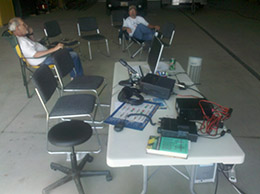
RACES volunteer operators are:
- Licensed Radio Amateurs
- Certified by a civil defense agency
- Able to communicate on Amateur Radio frequencies during drills, exercises and emergencies
- Activated by local, county and state jurisdictions and are the only Amateur Radio operators authorized to transmit during declared emergencies when the President of the United States specifically invokes the War Powers Act.
RACES Resource Library:
-
This web site is intended to assist
in the distribution of Chautauqua County NY
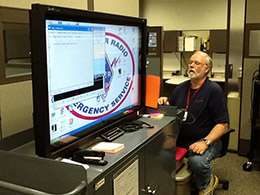 RACES Auxiliary Emergency Communications
information. Updated RACES documentation and other emergency
preparedness documents are available through the
RACES Resource Library,
maintained by RACES volunteers registered with the Chautauqua County,
New Youk Office of Emergency Management:
RACES Auxiliary Emergency Communications
information. Updated RACES documentation and other emergency
preparedness documents are available through the
RACES Resource Library,
maintained by RACES volunteers registered with the Chautauqua County,
New Youk Office of Emergency Management:See: NIMS Emergency Support Function #2.
Read our SOP: The NYS RACES SOP
Apply for a membership at: RACES Membership form
National Incident Management System:
-
Protocols embraced by RACES volunteers across the
nation include the National Incident Management System (NIMS),
which provides a consistent nationwide template to enable federal,
state and local governments, nongovernmental organizations, and the
private sector to work together to protect against, respond to, recover
from, and mitigate the effects of incidents.
R.A.C.E.S.
Chautauqua
County NY RACES
Radio
Amateur Civil Emergency Service
Chautauqua
County Emergency Manager Noel M. Guttman
RACES
County
Radio Officer Dave Thompson AB2WL
Assistant Radio Officer
Ken Vossler KG2CU
Assistant Radio Officer
Tom Joneson W2TLJ
Assistant Radio Officer
Terry Roberts KC2VCO
RACES
Repeater K2HE 146.880 MHz K2HE (-duplex) 123.0 Hz
RACES Repeater (backup) W2SB 146.625 MHz (-duplex) PL:127.3 Hz
RACES
RMS Sites 145.010 N2LRG-10 and 145.010 W2TLJ-10
Portable
Repeater AB2WL 145.250 MHz (-duplex) PL: 127.3 Hz